
About the Artist.
Arkin Demirel (b. 1979) is a French-Turkish contemporary artist known for his poetic, abstract compositions that explore memory, silence, and identity. Working primarily with acrylics, Demirel creates meditative paintings marked by rhythmic lines, luminous contrasts, and a subtle interplay between stillness and motion.
Born in Izmir and based in Paris, he draws inspiration from both Mediterranean light and the shadowed geometry of European cities. His work echoes the fluidity of water, the layering of time, and the unsaid—what is felt rather than spoken. A recurring theme in his practice is the healing potential of art: each painting seeks to restore balance, preserve traces of inner worlds, and offer viewers a space of reflection.
You can read an insightful profile of Arkin Demirel in Paris la Douce, a Paris-based culture and lifestyle magazine, from December 2014 here: “Portrait of a Parisian: A Meeting with Arkin Demirel, Emerging Painter” (pdf)
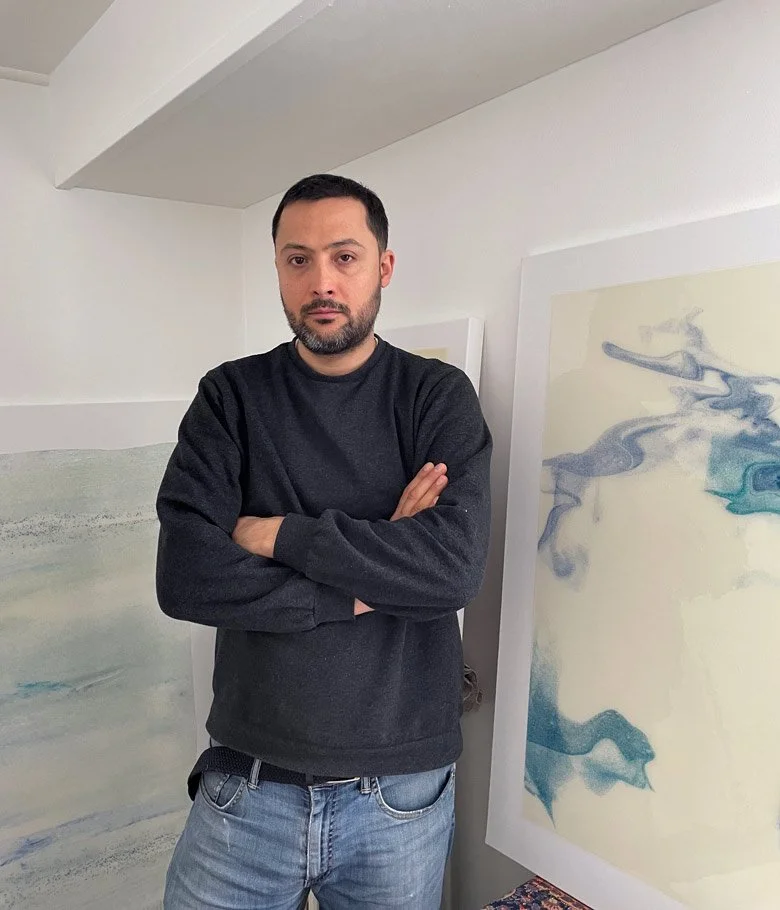
Arkın Demirel in his Anjou studio in 2022
With visual influences ranging from calligraphy and architecture to musical notation and childhood memories, Demirel’s canvases act as silent conversations. They evoke the misty mornings of Paris, the fragemented voices of uprooting, and the deep scars left by forgotten stories. Black, white, and shades of blue and green form the backbone of his palette—chosen not for their symbolism, but for their ability to carry emotion and silence with dignity.
Demirel rejects fixed boundaries, whether national or conceptual. For him, painting is a universal language that crosses borders and dissolves conflict. In his visual vocabulary, earth, sea, sky, and metal become metaphors for emotion, resilience, and connection.
His works have been featured in both independent exhibitions and curated spaces, including a selection by the Saatchi Gallery team for their official Instagram in 2016. Today, they are held in several private collections across Europe and beyond.
Arkin Demirel continues to paint between Paris and Anjou, weaving light into matter and silence into form.

Arkın Demirel in his Paris studio in 2014 © Photo by Paris la douce
About the Artist’s Practice
Arkin Demirel does not seek to represent the world. Instead, he investigates what constitutes it before it becomes an image.
For more than a decade, he has developed a visual language rooted in matter, its transformations, and its capacity to generate ambiguous forms. His work never begins with a narrative, a character, or an identifiable subject. It emerges from an encounter with physical phenomena: pigments, liquids, surface reactions, deposits, tensions, and processes of erasure.
What interests him is the moment when matter ceases to be merely matter and begins to evoke something else.
At this threshold, landscapes, organisms, cartographies, cells, oceans, galaxies, and sometimes human faces begin to emerge. Nothing is explicitly represented; everything is suggested.
The viewer completes the work.
This ambiguity lies at the core of his artistic research.
His paintings and moving-image works are guided by the same underlying logic. Plastikklip is not an independent project but the temporal extension of his painting practice. While painting captures a single state of matter, video allows its transformation to unfold over time. The image becomes an event.
All the images used in his videos originate from real physical phenomena. He employs neither artificial intelligence, computer-generated imagery (CGI), nor 3D animation. Everything that appears on screen exists physically. His practice seeks to reveal the transformative potential already contained within matter itself.
Scale plays a fundamental role.
The viewer is constantly uncertain about what is being observed. Is it a few millimetres of material or an immense landscape? A physical reaction, a topography, a living organism, or the trace of a geological event?
Arkin Demirel deliberately cultivates this state of uncertainty.
By removing familiar points of reference, he encourages the viewer to move beyond recognition toward a more intuitive and perceptual experience of the image.
Over the years, another phenomenon has progressively emerged within his work: the appearance of human figures.
These faces are never intentionally depicted. They arise from the accidents of matter, like memories resisting complete disappearance. Anonymous, incomplete, and often on the verge of erasure, they remain suspended between presence and absence.
They do not tell individual stories.
Rather, they evoke collective memory, disappearance, and the traces that human beings leave behind.
His ongoing series, Unutulmuşlar Müzesi (The Museum of the Forgotten), extends this investigation. It explores the ways in which individuals gradually become residual presences, absorbed by time and by matter itself.
His work is often perceived as contemplative or aesthetically seductive.
He does not seek to contradict this initial impression.
On the contrary, he invites viewers to enter the work through fascination before gradually revealing its underlying tensions.
Beauty becomes a silent trap.
Beneath this visual attraction lie questions concerning the continuous transformation of living systems, entropy, disappearance, the impact of human activity on the environment, and, more broadly, the fragility of all forms of existence.
Arkin Demirel does not create images of catastrophe.
He is interested in what remains after them.
His works do not seek to deliver a message or illustrate a concept.
They offer a space for observation.
A place where the viewer accepts, for a brief moment, not knowing exactly what they are looking at.
Today, he considers painting, video, monumental projection, and still images extracted from his moving-image works to be components of a single body of work.
Each medium investigates the same phenomenon through a different temporality.
Arkin Demirel is not interested in multiplying media. He is committed to deepening one continuous artistic inquiry.